
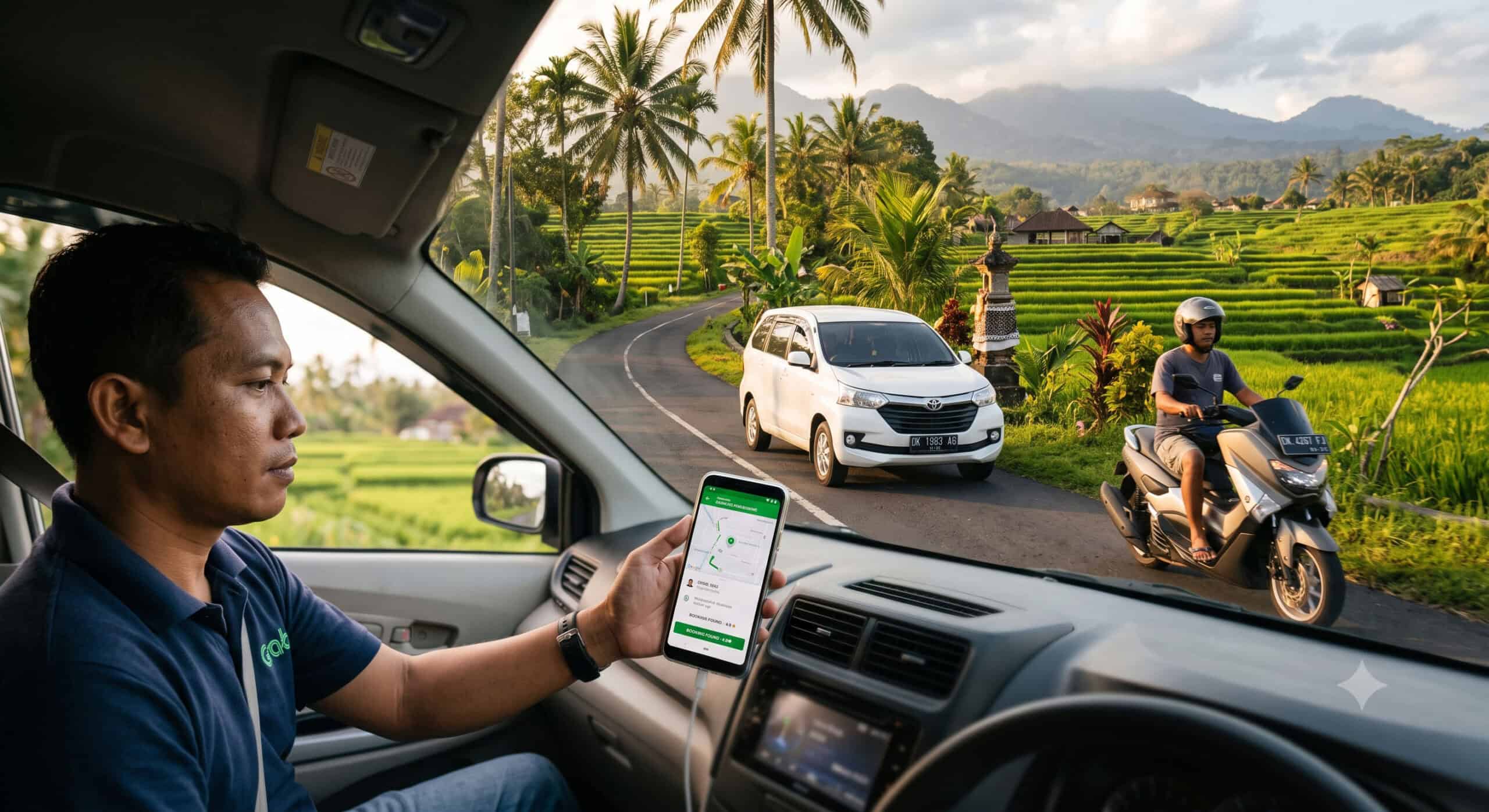
Bali looks compact on a map — an island you could supposedly loop in a single day. Spend twenty minutes stuck on Sunset Road in Canggu at 5 p.m. and that idea falls apart fast. Getting around Bali isn’t complicated once you know which app to open and which roads to avoid at rush hour, but the sheer number of options — taxis, Grab, Gojek, private drivers, scooters, boats — trips up a lot of people fresh off the plane at Denpasar. If you haven’t locked down how you’re flying into Bali yet, start there first. This guide walks through what actually works in 2026, what things cost in general terms, and a newer enforcement change that scooter renters can’t afford to ignore.
The Fastest Way to Get Around Bali: Grab vs. Gojek
Grab and Gojek are the two apps you’ll open more than any other on a Bali trip, and for most visitors they’ve replaced taxis entirely. Both work like Uber: open the app, drop a pin, and a car or motorbike shows up. GrabCar and GoCar are air-conditioned and make sense with luggage or a group; GrabBike and GoRide are the two-wheeled versions and usually beat cars through traffic, especially in Seminyak and Canggu during peak hours.
Gojek tends to run slightly cheaper on short motorbike hops, while Grab is the one most tourists default to for cars and longer rides. Download both through the official Grab app before you land, and make sure your Bali SIM or eSIM is active the moment you touch down, since you’ll need data to book that first ride. Cash in Indonesian Rupiah still gets used constantly, though both apps support cashless payment depending on your account setup, so keep small bills as a backup either way.
One quirk worth knowing: in some areas near beaches and transport hubs, local driver groups discourage ride-hailing pickups. If your ride keeps getting canceled or the pickup point feels off, don’t argue — just walk a few minutes to the nearest main road and try again. It works almost every time.
Bluebird Taxis, Shuttles, and Old-School Ojek
Taxis are everywhere in Kuta, Seminyak, and parts of Denpasar, and they’re genuinely useful when your phone’s dying or it’s pouring rain and you just want a door-to-door ride without fiddling with an app. Bluebird is the name to know — it’s the most consistently metered, reputable operator on the island, and booking through the MyBluebird app gives you a fixed pickup point instead of standing on a curb hoping a taxi rolls by.
Bali doesn’t have much in the way of public transit, but Kura-Kura Bus runs fixed routes between some of the busier tourist corridors — worth checking current routes once you land, since both can shift. Larger resorts, especially around Nusa Dua, often run their own shuttles to shopping areas or nearby beaches, so ask at the front desk before assuming you need a paid ride.
Before the apps existed, Bali had ojek — independent motorcycle taxis you’ll still spot near markets and busy corners. Agree on a price before you get on, ask for a helmet without hesitation, and if your driver’s riding too aggressively, “pelan-pelan ya” (slowly, please) usually gets the message across. For most visitors, GrabBike or GoRide does the same job with a tracked route and a rated driver.
Private Drivers: Worth It for Big Sightseeing Days
If you’re trying to cover temples, waterfalls, rice terraces, and a beach club in one day, a private driver beats juggling four separate app rides. You set the pace, skip the stops that don’t interest you, and get someone who actually knows which back road avoids the Ubud traffic jam. Most hotels and villas can arrange one directly, and drivers who work through traveler communities and repeat referrals tend to be the most reliable.
Before you book, confirm three things: how many hours are included (8 to 10 is typical for a full day), whether fuel and parking are covered, and what the overtime rate is if your day runs long. If you’re basing yourself somewhere like Ubud for the cultural sites, a private driver pairs especially well with a stay at one of Bali’s jungle resorts near Ubud, since a lot of the best temple routes start from that side of the island.
Scooter Rentals: The 2026 Rule Nobody Tells You About
Scooters are cheap, everywhere, and the fastest way to turn a relaxed vacation into an emergency room visit if you’re not an experienced rider. If you’re going to ride, you need two things most rental shops won’t mention upfront: a genuine motorcycle license from home, and an International Driving Permit (IDP) that covers Category A motorcycles. Indonesia only recognizes IDPs issued under the 1949 Geneva Convention, which covers most Western countries — U.S. drivers can apply for one through AAA before they leave.
This matters more in 2026 than it used to. Bali rolled out the “Dharma Dewata” enforcement task force this year specifically targeting foreign drivers without proper documentation, and checks in tourist-heavy areas like Canggu, Uluwatu, Seminyak, and Ubud are noticeably more consistent than the informal, look-the-other-way enforcement of past years. Fines have gone up too. And if you crash without a valid IDP, most travel insurance policies will flatly deny the claim — which turns a scraped knee into a bill you’re paying yourself.
- Wear a real helmet every time, and make sure it actually fits
- Skip riding at night or in heavy rain
- Never hand over your passport as a rental deposit — cash only
- Mount your phone for navigation instead of holding it out while riding
Fast Boats and Ferries: Getting to Nusa Penida and the Gilis
If island-hopping is part of the plan — and it should be, Nusa Penida alone justifies the trip — fast boats are the standard way to reach Nusa Penida, Nusa Lembongan, and the Gili Islands. If you haven’t nailed down what to actually do once you’re out there, a look at Bali’s best activities helps you figure out which crossing to book first.
Morning departures tend to have calmer water than afternoon crossings, and operators will reschedule for weather more often than you’d think — take them up on it. Stick to operators who provide life jackets and a real boarding process; fast boat incidents in the region have made news in recent years, and this isn’t a crossing to book on price alone.
Ferries are the slower, cheaper alternative, especially useful if you’re bringing a vehicle or don’t want the speedboat bounce. Logistics are less tourist-polished than the fast boat operators, so build extra time into that part of your day.
Getting Around Bali’s Most Popular Areas
Kuta
Kuta is dense, walkable in pockets, and thick with taxis. Bluebird and Grab or Gojek cover most needs, and short walks handle the rest. Scooters here can feel more stressful than fun given how unpredictable the traffic gets.
Seminyak
Seminyak spreads out more than Kuta, and traffic crawls at sunset. Grab or Gojek work well for short hops, Bluebird is a solid backup, and a private driver makes sense for beach club and sunset dinner plans.
Ubud
Ubud isn’t a walk-everywhere town unless you’re staying dead center. Private drivers are the most efficient way to hit the rice terraces and temples, Grab or Gojek pickup points can be inconsistent here, and your accommodation can usually arrange a taxi directly. If you’re picking where to stay for easy access to the sights, our guide to Bali’s best places to stay breaks down which towns work best for which kind of trip.
Canggu
Canggu’s traffic has its own reputation, and not a good one. GrabBike or GoRide beats sitting in a car for solo trips, private drivers make sense for longer routes, and scooters only make sense if you’re genuinely experienced and cautious — this is one of the areas where the 2026 enforcement checks show up most.
Frequently Asked Questions About Getting Around Bali
Is Uber available in Bali?
No. Uber sold its Southeast Asian operations to Grab back in 2018, so the app technically still opens in Bali but won’t find you a driver. Grab and Gojek are the direct replacements, and Grab actually holds a stake from that deal, so you’re using a version of the same network either way.
Are Grab and Gojek allowed everywhere in Bali?
Mostly, but not universally. Some tourist areas have informal pushback against ride-hailing pickups from local driver groups. If a pickup gets canceled repeatedly or feels tense, walk a few minutes to a main road and rebook — it almost always resolves the issue.
What’s the safest transport option for families?
A private driver or a metered Bluebird taxi. Both are calm, predictable, and don’t require anyone to sit on the back of a motorbike, which matters more with kids in the mix.
Do I actually need an International Driving Permit to ride a scooter?
Yes, and 2026’s stricter enforcement makes this less optional than it used to be. Without a valid IDP covering motorcycles, you’re both breaking the law and risking a denied insurance claim if something goes wrong.
How much should I budget for transport per day?
It varies a lot by how much ground you’re covering, but a mix of Grab or Gojek rides for short hops and one private driver day for sightseeing covers most itineraries without requiring a rental car or scooter at all.
Bali’s transport options look overwhelming on paper and sort themselves out fast once you’re actually there. Download Grab and Gojek before you land, keep Bluebird as your backup, and save the scooter for a day when you’ve actually sorted the IDP — the island rewards people who take that one step seriously.
Recent Posts
Frankfurt Airport Layover Guide: What to Do With 6–24 Hours (2026)
Frankfurt Airport (FRA) is Europe's fourth-busiest airport, which means the odds of getting routed through it on your way to Prague, Nairobi, or Bangkok are pretty good — and so is the chance...
You're staring at a scooter accident video on TikTok, a headline about a missing tourist, and a friend's warning about "that Bali crime wave," and you're wondering: is Bali safe in 2026? Short...