
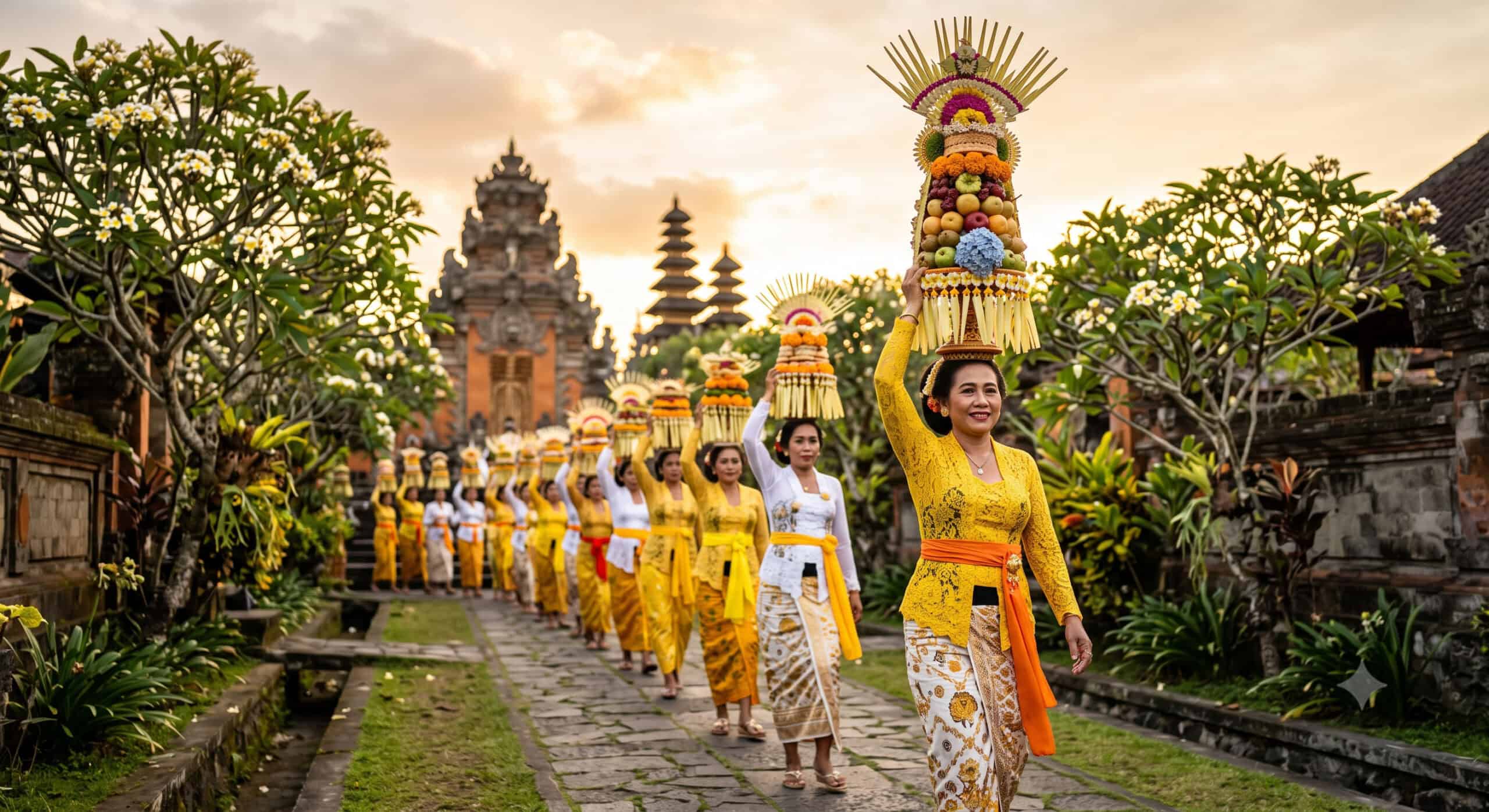
Bali gets under your skin fast. Within 24 hours of landing, most first-timers have stumbled into a temple procession they weren’t expecting, navigated an ATM with sketchy vibes, and seriously reconsidered their decision to rent a scooter. The island is genuinely wonderful — and like any place that draws this many visitors, it has a few things you really should know before you show up. This guide covers seven practical, commonly overlooked realities of Bali travel, plus what’s actually changed heading into 2026. Know these going in and the island will reward you.
1. Balinese Hinduism Shapes Daily Life Here
Indonesia is majority Muslim. Bali is not. The island is predominantly Hindu, and that shapes the experience in ways that are hard to overstate. Balinese Hinduism isn’t background scenery — it’s in the tiny palm-leaf offerings placed on sidewalks each morning, the sound of gamelan drifting out of a neighborhood temple on a random Wednesday, and the processions of women in ceremonial dress carrying towers of offerings on their heads during festivals that happen throughout the year.
What that means for you as a visitor: you’ll encounter canang sari (daily offerings) in doorways, on car hoods, and right in the middle of the path. They’re beautiful and sacred, so try not to step on them. If you walk into a ceremony in progress, watch from the side, keep voices low, and don’t block walkways. These moments are honestly some of the best you’ll have in Bali — spontaneous, real, and free.
One holiday demands specific planning: Nyepi, the Balinese Day of Silence, falls in March and shuts the entire island down for 24 hours — including the airport. No lights, no driving, no going outside. It’s extraordinary if you’re prepared for it, genuinely confusing if you’re not. Our guide to the best time to visit Bali covers Nyepi and how to plan around it.
2. Temple Rules Are Real — Including One That Surprises Visitors
Bali has thousands of temples, and visiting at least one should be on every itinerary. Tanah Lot, Uluwatu, Pura Tirta Empul — they’re extraordinary. But temples are active places of worship, not photo sets, and a few ground rules apply that aren’t optional.
The basics: cover your shoulders and knees. Most temples provide sarongs to borrow at the entrance, though many travelers pick up a brightly patterned one from a market vendor on the way in — they’re far nicer than the rental versions, and they cost almost nothing. For a full breakdown of temple dress and what to wear in each area of Bali, our Bali packing and dress guide has you covered. Don’t climb shrines, don’t position yourself in front of worshippers to get a shot, and don’t treat a sacred space like a backdrop.
The rule that catches some Western visitors off guard: Bali’s official tourist guidelines specify that menstruating women should not enter certain sacred inner temple areas, based on local beliefs about ritual purity. It’s not enforced with any kind of inspection — it’s simply a cultural norm that’s worth knowing about and respecting. The practical approach is to visit outer temple grounds that day, or choose a different activity and return another time. It’s a small accommodation that goes a long way.
3. Protect Your Cards: ATM Skimming Is a Known Issue
Bali is easy for money — ATMs are everywhere in tourist areas, and card payments work at most mid-range and upscale establishments. But card skimming and fraud do happen, most often at standalone street ATMs that have weak security and low oversight. The fix is simple: use ATMs inside a bank branch, inside a reputable mall, or in a well-monitored hotel lobby. Cover the keypad every time you enter your PIN.
A few habits worth building before you leave home: turn on real-time transaction alerts with your bank, set a daily withdrawal limit that doesn’t expose your full account if something goes wrong, and bring two cards stored separately. Also — notify your bank that you’re traveling to Indonesia. Indonesian transactions trigger fraud flags on many U.S. and European accounts, and a locked card on day one of your Bali trip is a genuinely miserable start.
4. Scooters Are Fun Until They’re Not
Renting a scooter in Bali is cheap, flexible, and gives you a freedom that no taxi can replicate. It’s also the number one way tourists end up injured. Road rash from a low-speed tip. A broken collarbone from a pothole nobody warned you about. Worse, from traffic that doesn’t expect you to be there and won’t yield.
A few firm rules: only ride if you have real experience on a motorbike. Bali is absolutely not the place to learn. Wear a helmet every single time — buckled properly, right-sized. Don’t ride after drinking, ever. And abandon any assumption that other drivers see you, because they often don’t. Bali traffic operates by its own logic: lanes are suggestions, gaps are invitations, and the default assumption is that the smaller vehicle moves.
For day trips covering multiple destinations, hiring a private driver is genuinely worth the money. Around $35–$50 covers a full day of comfortable transport to temples, rice terraces, and waterfalls, and your driver typically doubles as a guide who knows where to park and which entrance gate is fastest. For short neighborhood trips in Canggu or Seminyak, Grab and Gojek (Bali’s ride-hailing apps) work well. You can still reach all the best things to do in Bali without putting yourself on a scooter in unfamiliar traffic.
5. Nighttime Safety: Low Risk, High Common Sense
Bali’s nightlife is genuinely good — beach bars with fire shows, live music, rooftop bars in Seminyak, and night markets worth staying up for. The after-dark scene in Canggu alone could fill a week. Serious crime against tourists is rare, but petty theft increases after dark, especially the opportunistic kind in busy tourist zones.
Keep your phone in a front pocket or bag when walking near roads — motorbike snatch-and-grab theft happens fast. A crossbody bag worn to the front is a reliable deterrent in crowded areas. Avoid walking quiet, unfamiliar roads alone late at night. If you’re on a scooter, don’t leave valuables loose in open pockets or an unclipped bag. And if you ever feel uncomfortable — ask a shop owner or security guard to help you get a safe ride. Balinese locals are remarkably willing to help travelers in these situations.
6. Indonesia’s Drug Laws Are Among the Harshest in Asia
This section is short because the point is simple: do not use illegal drugs in Bali. Indonesia has some of the most severe narcotics laws in the region. Possession can result in heavy fines and long prison sentences. Trafficking charges — depending on substance and quantity — can carry life imprisonment or the death penalty under Indonesian law. These laws apply equally to foreign visitors, and there are no diplomatic exceptions.
Police have conducted raids on venues associated with drug use in Bali’s tourist areas. Travelers have been required to take drug tests on the basis of suspicion. If someone offers you something in a tourist area, the answer is no — and keep walking. No gray area here.
7. The Arak and Methanol Risk Is Real — Here’s How to Stay Safe
Arak — Bali’s traditional palm-spirit — is genuinely worth trying when it comes from a reputable, licensed establishment. The risk isn’t arak itself; it’s unregulated or adulterated alcohol mixed with methanol, a colorless and odorless substance that is potentially fatal even in small quantities. Multiple government travel advisories have flagged methanol poisoning as a documented risk in Indonesia, with incidents concentrated around very cheap cocktails at unregulated venues, mystery “happy shots,” and unlabeled bottles.
The practical approach: drink at licensed hotels, established restaurants, and bars that have a track record. Be cautious with suspiciously cheap cocktails or anything poured from an unlabeled bottle. Prefer sealed beer cans or named spirits when you’re somewhere unfamiliar. Don’t leave a drink unattended, and watch it being poured when possible.
Know the warning signs of methanol poisoning: severe headache, nausea, blurred or disturbed vision, and confusion. If you or someone with you suddenly feels very unwell after drinking, seek medical help immediately. Don’t sleep it off — methanol poisoning can be fatal and time matters.
Travel Insurance for Bali: Don’t Skip It
Bali is not a dangerous destination, but the mix of scooter culture, water activities, surf, and the occasional bout of Bali Belly makes travel insurance a practical necessity rather than a nice-to-have. Private hospitals in tourist areas (BIMC in Kuta and Canggu is the standard recommendation) are good and well-equipped, but serious injuries or illnesses can cost far more than the policy.
A solid policy for Bali should cover: emergency medical care and hospitalization, medical evacuation (air ambulance from Bali to Singapore or Australia runs tens of thousands of dollars without coverage), trip cancellation, and lost or stolen gear. If you’re surfing, diving, or doing any adventure sports, verify that your policy covers those activities specifically — many standard travel policies exclude them. U.S. health insurance rarely provides meaningful international coverage, so if that describes you, medical travel coverage is non-negotiable.
2026 Updates Worth Knowing Before You Go
Bali Tourist Levy: Every foreign visitor pays a one-time IDR 150,000 (roughly $9) entry levy per person. Pay online via the official Love Bali portal before departure and download your QR code, or pay at a counter on arrival. Keep the confirmation — some attractions and checkpoints now verify it.
Indonesia’s new criminal code (KUHP): Took effect January 2, 2026. The provision most relevant to tourists is Article 412, which covers cohabitation outside marriage — but it’s complaint-based, meaning only close family members can file. For most travelers, the practical impact is minimal. That said, check the travel advisory from your own government for nationality-specific guidance, since the interpretations and advisories vary.
Getting to Bali: There are no nonstop flights from the U.S. — at least one layover (often through Singapore, Hong Kong, Seoul, or Doha) is standard. Our detailed guide to flying to Bali from the United States covers routing, airlines, arrival procedures, and exactly what to expect at Ngurah Rai Airport. And once you’ve decided when to go, our guide on where to stay in Bali will help you pick the right base for your trip.
Frequently Asked Questions About Visiting Bali
Is Bali safe for solo female travelers?
Yes — Bali is widely considered safe for solo female travelers, and millions visit each year without incident. Standard precautions apply: stay aware at night, avoid isolated areas late, keep valuables secured, and trust your instincts. Tourist hubs like Ubud, Seminyak, and Canggu have strong infrastructure for solo travelers, including plenty of co-working cafes, well-reviewed hostels, and active traveler communities.
Do I need a visa to visit Bali?
Most passport holders can enter on a Visa on Arrival (e-VOA), valid for 30 days and extendable once for another 30 days. The cost is IDR 500,000 (roughly $30). Some nationalities qualify for visa-free entry. Verify your eligibility on Indonesia’s official immigration portal before you travel, as the list changes. Separately, all visitors pay the Bali Tourist Levy of IDR 150,000.
What is Bali Belly and how do you avoid it?
Bali Belly is traveler’s diarrhea, typically caused by consuming food or drinks prepared with unfiltered tap water rather than the food itself. To reduce your risk: drink bottled or filtered water only (including for brushing teeth if you’re sensitive), eat at busy stalls with high turnover, and go easy on raw vegetables unless you’re at a reputable restaurant. Many travelers go through a full Bali trip with no issues at all; going in prepared makes a significant difference.
What is the dress code at Bali temples?
Shoulders and knees must be covered to enter most temples. Many temples lend sarongs at the entrance — some for free, some for a small fee. Carrying your own lightweight sarong is practical and gives you access to smaller, less-touristed temples that don’t provide them. If you plan to visit multiple temples in a day, wearing one throughout is easiest.
Is it safe to drink the tap water in Bali?
No — tap water in Bali is not safe to drink. Stick to bottled water or use a filtered water bottle, both of which are widely available. Most hotels provide complimentary bottled water; many cafes offer free refills if you bring a reusable bottle. Ice at established restaurants and hotels is generally made from filtered water, but exercise more caution at street-level stalls.
Should I rent a scooter or hire a private driver in Bali?
If you have real motorbike experience and plan to stay within a specific area, a scooter offers great flexibility at very low cost. For day trips covering multiple destinations — or for anyone without genuine riding experience — a private driver is the smarter call. At around $35–$50 for a full day, the cost is easy to split between two people, and the driver often knows exactly which back roads, parking spots, and viewpoints to use.
Bali doesn’t require fear — just a bit of cultural awareness and practical common sense. The island is generous with its rewards for travelers who show up respectfully and prepared. Get those basics right and the rest takes care of itself.
Recent Posts
Frankfurt Airport Layover Guide: What to Do With 6–24 Hours (2026)
Frankfurt Airport (FRA) is Europe's fourth-busiest airport, which means the odds of getting routed through it on your way to Prague, Nairobi, or Bangkok are pretty good — and so is the chance...
You're staring at a scooter accident video on TikTok, a headline about a missing tourist, and a friend's warning about "that Bali crime wave," and you're wondering: is Bali safe in 2026? Short...