
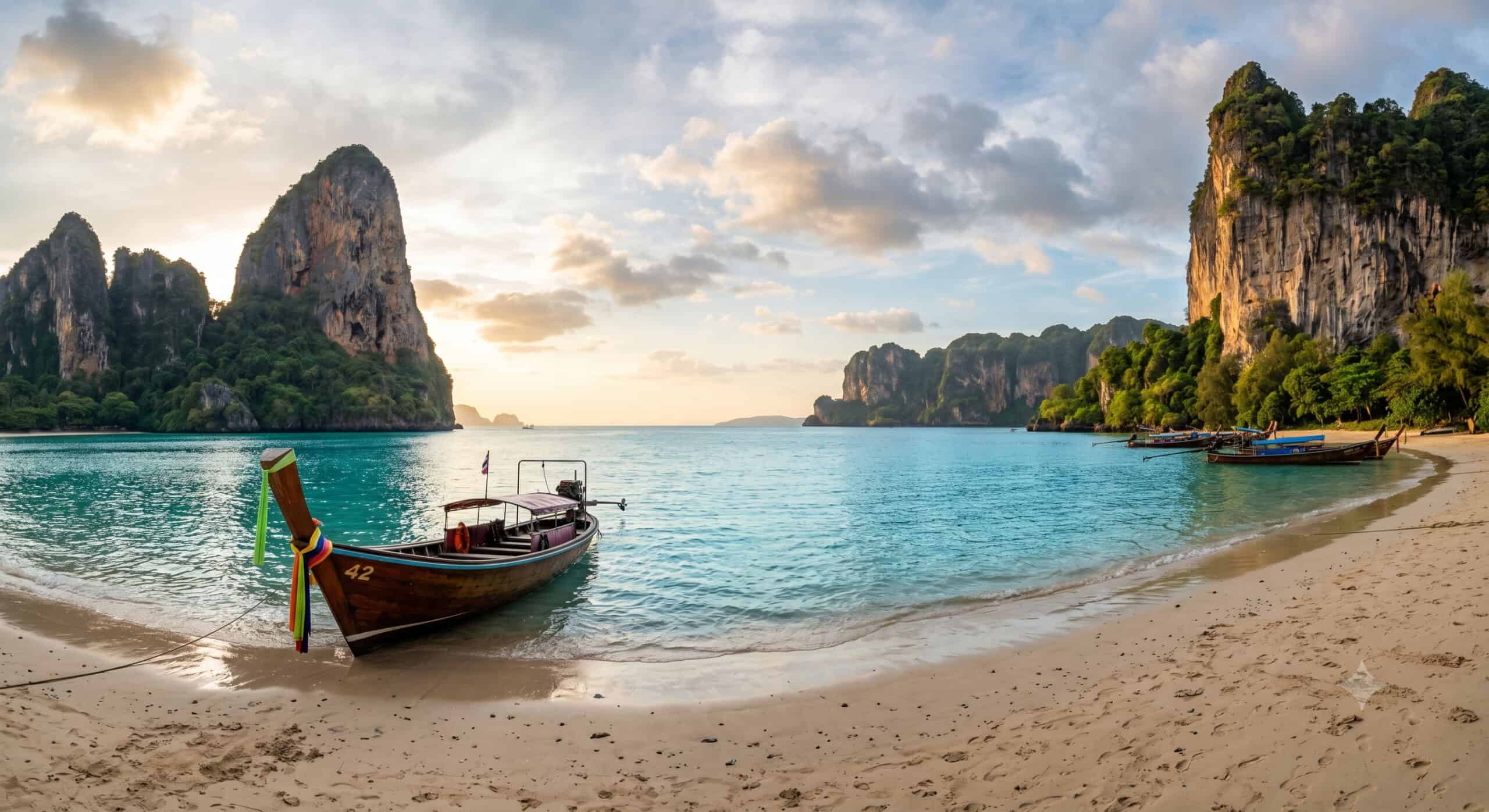
Thailand pulls off something most countries can’t manage: four entirely different travel experiences packed into one trip. Start the week wandering a Bangkok street-food market, spend two afternoons in the shadow of 14th-century ruins, wake up to mountain mist in Chiang Mai, and finish it all floating in clear Andaman water off Railay Beach. This 10-day Thailand itinerary covers the country’s classic first-timer circuit — Bangkok, Ayutthaya, Chiang Mai, and Krabi — with enough breathing room to actually enjoy each stop instead of sprinting through it. If you’re weighing Thailand against another Southeast Asia destination, our Thailand vs. Bali comparison breaks down how the two stack up for different travel styles.
At a Glance: Your 10 Days in Thailand
- Days 1–3: Bangkok — temples, neighborhoods, street food, and city transit
- Days 4–5: Ayutthaya — UNESCO ruins and the old Siamese capital
- Days 6–7: Chiang Mai — Old City temples, mountain views, and night markets
- Days 8–10: Krabi — Railay Beach, island hopping, and the Emerald Pool
Days 1–3: Bangkok — Temples, Street Food, and the Art of Getting Around
Bangkok rewards the traveler who resists the urge to see everything. Trying to cross the whole city in one day will leave you hot, stuck in traffic, and irritated. The better approach: pick one area per day, go deep, and let the city come to you. The BTS Skytrain does the heavy lifting — it’s fast, fully air-conditioned, and cheap. Grab a stored-value Rabbit Card at any station on Day 1 and thank yourself every day after.
Day 1: The Grand Palace Circuit
Get to the Grand Palace and Wat Phra Kaew (Temple of the Emerald Buddha) before 9 a.m. — the site is genuinely more impressive in person than in photos, and the morning hour means cooler air and smaller crowds. Budget two to three hours for the palace complex, then take the short river ferry across to Wat Arun. The porcelain-mosaic towers reward a close look, and the view back toward the Grand Palace from the riverside terrace is one of Bangkok’s best. Dress requirement: covered shoulders and knees are mandatory at both temples. Forgot? Vendors outside sell wraps for roughly 20 baht.
Day 2: Neighborhood Wandering and Chinatown After Dark
Day 2 is for slowing down. The Old Town area around Rattanakosin mixes smaller temples, river views, and local cafés at a pace that feels nothing like the tourist-circuit grind. Save your appetite for evening: head to Yaowarat (Bangkok’s Chinatown) and eat everything in sight. Peppery crab soup, grilled river prawns, roasted duck on rice, mango sticky rice from a cart — this stretch of road competes with any food destination in the world. If you’re planning to spend time at Khao San Road or Bangkok’s rooftop bars, our guide to Thailand’s alcohol laws and Bangkok nightlife rules covers hours, ID requirements, and what to know before heading out.
Day 3: Markets and City Confidence
If Day 3 falls on a weekend, Chatuchak Weekend Market is the plan: one of the world’s largest outdoor markets, with hundreds of stalls covering ceramics, vintage clothing, handmade goods, plants, and street food that holds its own against anything else in the city. On a weekday, a morning boat ride along the Chao Phraya or a relaxed afternoon at Bangkok’s Museum of Contemporary Art works just as well.
Use today to get fully comfortable with the BTS interchange points at Siam and Asok — once those click, navigating Bangkok stops feeling like a guessing game. If you’re considering adding a beach day near Bangkok on either end of this trip, Hua Hin is an easy two-to-three-hour drive south and is a completely different pace from the capital.
Days 4–5: Ayutthaya — Where the Old Kingdom Speaks in Ruins
About 80 kilometers north of Bangkok, Ayutthaya was once one of the largest and wealthiest cities on the planet — the capital of the Siamese Kingdom from 1350 until Burmese forces razed it in 1767. What’s left is a landscape of crumbling prangs, stone Buddhas buried to their necks by centuries of tree growth, and wide temple corridors that feel genuinely haunted. It’s been a UNESCO World Heritage Site since 1991, and the designation is earned.
Day 4: Travel and the Main Temple Loop
The train from Hua Lamphong station takes about 90 minutes and costs very little — it’s also one of the more scenic short rides near Bangkok. Once there, rent a bicycle: the flat terrain and short distances between ruins make cycling both practical and enjoyable. Wat Phra Si Sanphet and Wat Chaiwatthanaram are the standouts — Chaiwatthanaram is particularly worth timing for golden hour, when the warm light turns the ancient brick towers a deep orange along the river. Tuk-tuk drivers also do curated temple loops for a negotiated flat fee, which works well in the midday heat when cycling feels less appealing.
Day 5: Context, Then Onward
Before leaving, an hour at the Ayutthaya Historical Study Centre gives the ruins real context — a timeline and a history lesson that makes everything you just photographed click into place. Then head back toward Bangkok to catch an evening domestic flight north. Bangkok to Chiang Mai takes about 75 minutes on any of the budget carriers (Thai AirAsia, Nok Air, Thai Lion Air) and costs very little when booked even a week ahead.
Days 6–7: Chiang Mai — Old City Temples, Mountain Air, and Northern Thai Food
The shift from Bangkok to Chiang Mai is like switching from espresso to tea. Chiang Mai has genuine Old City walls, more than 300 temples, and a pace that actually gives you time to look at things. Northern Thai food alone — kao soi curry noodles, sai oua sausage, sticky rice with everything — is reason enough to make the trip. The city is also one of the most walkable on this entire itinerary.
Day 6: Inside the Old City Walls
Start at Wat Phra Singh, one of the most significant temples in northern Thailand, with a beautifully detailed assembly hall and an atmosphere that feels noticeably less tourist-trafficked than the Bangkok circuit. Nearby Wat Chedi Luang has a massive partially ruined chedi dating to the 1400s — quiet, atmospheric, and worth the short walk. In the evening, the Chiang Mai Night Bazaar on Chang Khlan Road is solid for casual shopping and street-food grazing. If Day 6 falls on a Sunday, the Walking Street on Wualai Road is a step up.
Day 7: Doi Suthep and the Mountain Reset
Wat Phra That Doi Suthep sits on a mountain about 15 kilometers above the city, reachable by shared red songthaew truck (cheap, frequent from near Chiang Mai University) or a private ride. The temple holds genuine religious significance for northern Thai Buddhists — not just a photo-op viewpoint — and the panorama over the city from the terrace is best in the morning before clouds roll in. Afterward, the Doi Suthep-Pui National Park has short trails and noticeably cooler air if you want some greenery time. Tonight: get a proper Thai massage somewhere reputable — Chiang Mai has some of the country’s best — and get to bed at a reasonable hour. Krabi comes next.
Days 8–10: Krabi — Railay, Island Hopping, and Emerald Water
The flight from Chiang Mai to Krabi takes about two hours (often connecting through Bangkok). Step off the plane and the air hits differently — warm, salt-tinged, and immediately relaxing. After three days of temples and history, Krabi’s limestone cliffs and clear Andaman water feel like the exhale the rest of the trip was building toward. Ao Nang makes the best base for most travelers — well-connected for tours, solid food options at every price, and easy water access. For a full breakdown of where to stay and which neighborhood fits your style, our Krabi hotels and area guide covers the options from budget to luxury.
Day 8: Arrive, Exhale, and Plan Tomorrow
Check in, walk the beach, eat fresh seafood at one of the grill-table restaurants along Ao Nang’s beachfront strip, and decide what you want from tomorrow’s boat day. That’s it. Krabi should feel like a decompression — don’t rush it.
Day 9: Island Hopping — Phi Phi and the Open Water
A speedboat day tour to the Phi Phi Islands is the quintessential Krabi day. Tours typically cover multiple stops: snorkeling sites with reef fish and blacktip sharks, the enclosed blue-green water of Pileh Lagoon, and a visit to Maya Bay. A few things to know about Maya Bay in 2026: swimming is permanently prohibited (knee-deep wading is the rule, designed to protect the reef sharks that use the shallows as a breeding ground), and the bay runs an annual conservation closure each year from August 1 through September 30. If your visit falls within that window, tours redirect to Pileh Lagoon, Bamboo Island, and snorkeling stops — genuinely excellent alternatives that aren’t just a consolation prize. If you’re drawn to quieter, less-visited spots beyond the standard Phi Phi circuit, our guide to Thailand’s hidden islands covers some peaceful off-the-radar alternatives.
Day 10: The Emerald Pool and a Final Dinner
Drive inland to Sa Morakot — the Emerald Pool in the Thung Teao Forest Natural Park — for your last Thai morning. The mineral-rich springs really do produce that improbable blue-green color, and the surrounding forest is cool and quiet in a way the beach never is. Go before 10 a.m. to beat the tour groups. Then head back to Krabi Town for a last seafood dinner, pack your bags, and start planning the return trip you’ll already be thinking about.
Essential Tips for 10 Days in Thailand
A few practical notes that make the difference between a smooth trip and an unnecessarily stressful one:
- Temple attire: Pack one outfit that covers shoulders and knees — you’ll need it at every major temple from Bangkok through Chiang Mai. Some sites turn visitors away at the door.
- Download Grab before you land. It works across Bangkok, Chiang Mai, and Krabi, and is consistently cheaper and more reliable than flagging down a street taxi.
- Don’t over-schedule transit days. This itinerary involves a lot of moving — Bangkok, Ayutthaya, back to Bangkok, Chiang Mai, Krabi. Leave buffer in each leg so one delayed flight doesn’t cascade into a missed afternoon.
- Travel insurance with medical evacuation is genuinely recommended, especially if you’re doing water sports or boat trips in Krabi.
- Hydrate constantly. Bangkok and Krabi are hot and humid year-round. Buy cold water constantly, carry a reusable bottle for refills, and go easy on alcohol on high-activity days.
Thailand Visa and Entry Notes (Updated June 2026)
Thailand’s entry rules have shifted significantly in 2026 — and the original 60-day visa-free window that many travelers relied on is changing. Thailand’s Cabinet approved a return to 30-day visa-free stays (down from 60 days) for visitors from 93 countries, including the United States, United Kingdom, Canada, and most of Europe, on May 19, 2026. The rule takes effect 15 days after publication in the Royal Thai Gazette. Check the official Thai Embassy website for your nationality to confirm the current status before booking.
There’s also a new digital entry requirement: the Thailand Digital Arrival Card (TDAC) is now mandatory for all foreign nationals arriving at major Thai airports and land crossings. It replaced the paper TM6 arrival card. Complete it online within 72 hours before your flight — the process takes about five minutes. Come prepared with your flight number, accommodation address in Thailand, and a photo of your passport.
If you plan to stay longer than 30 days, a one-time 30-day extension is available at any Thai immigration office for approximately 1,900 THB (~$55 USD). Verify your country’s specific requirements with your embassy or consulate before departure.
Frequently Asked Questions About the Thailand 10-Day Itinerary
Is 10 days enough to see Thailand?
Ten days is a solid first-timer window. You’ll cover Bangkok, Ayutthaya, Chiang Mai, and Krabi with enough time to enjoy each stop rather than race through it. You’ll also leave with a clear list of what to come back for — the northern trekking routes, the Gulf islands, the slower parts of the south. Travelers who want more depth in fewer places could drop Ayutthaya and add an extra day in Bangkok or Chiang Mai.
How much does a 10-day Thailand trip cost?
It depends heavily on travel style. On a mid-range budget — comfortable guesthouses, a mix of street food and sit-down meals, domestic flights for the longer legs — most travelers spend $70–$120 USD per day all-in including accommodation. Budget travelers can stretch to $40–$60 per day. Thailand is consistently excellent value relative to what you get, and the food alone is worth the trip cost at any budget level.
What’s the best time of year to visit Thailand?
November through February is the sweet spot: dry season across all four regions, comfortable temperatures in Chiang Mai, and the best beach conditions in Krabi. March and April get genuinely hot everywhere — especially Bangkok, where humidity and heat combine aggressively. May through October brings rain and cooler temperatures to the north, while rougher Andaman Sea conditions can affect boat access to Krabi’s islands.
Do U.S. tourists need a visa for Thailand?
U.S. citizens remain eligible for visa-free entry to Thailand. However, the permitted stay is changing: Thailand’s cabinet approved a return to 30-day visa-free stays (down from 60 days) on May 19, 2026, effective 15 days after Royal Thai Gazette publication. Verify the current status at the Thai Embassy website before you travel. A 30-day extension is available at Thai immigration offices for approximately 1,900 THB if you need more time. Also note: a new two-visits-per-year limit on visa-free entries was introduced in late 2025 for repeat border-runners.
Is Thailand safe for first-time travelers?
Thailand is generally one of the safer destinations in Southeast Asia for tourists. Standard precautions apply: watch your belongings in crowded markets, use Grab or registered taxis, don’t leave drinks unattended at bars, and be aware of the most common tourist scams. Near major Bangkok temples, the two classics are the “gem shop” scam (a friendly local steers you to a store claiming a once-a-year sale) and the “that temple is closed today, let me show you a better one” approach. Both are easily avoided by heading directly to your destination without engaging unsolicited guides.
How do I get between cities on this itinerary?
Bangkok to Ayutthaya: train from Hua Lamphong station, about 90 minutes, very inexpensive. Ayutthaya back to Bangkok, then onward to Chiang Mai: domestic flight from Don Mueang or Suvarnabhumi (75 minutes; book Thai AirAsia, Nok Air, or Thai Lion Air for lowest prices). Chiang Mai to Krabi: fly direct or connect via Bangkok, about two hours total. Booking domestic flights one to three weeks ahead keeps costs manageable — often under $40 USD each way. Day-of booking is possible but pricier.
Ready to Book Your Thailand Trip?
This route through Thailand isn’t trying to show you everything — it’s built to show you the right things in the right order. Bangkok hooks you on city energy and street food. Ayutthaya makes you rethink the word “ancient.” Chiang Mai slows everything down. And Krabi makes you want to extend the whole trip by a week. Book the flights, pack light, and eat everything you can at every market you pass.