
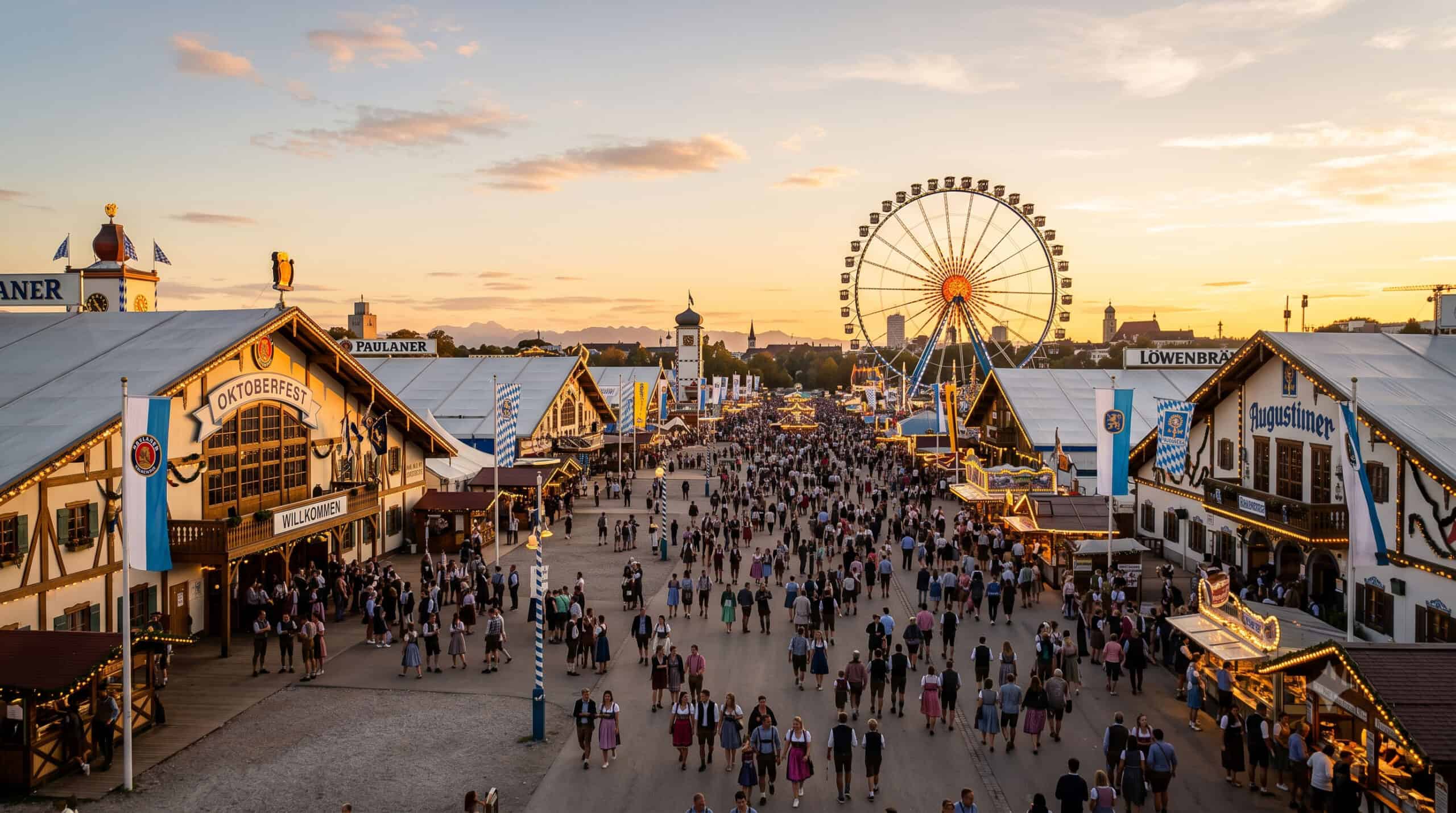
Oktoberfest 2026 runs September 19 through October 4 on Munich’s Theresienwiese — sixteen days, roughly seven million visitors, and enough beer to float a small navy. If you’ve never gone, the logistics can eat your trip alive: hotel rooms in Munich’s old town start vanishing months out, the tents everyone’s heard of fill their reserved tables before most people even start looking, and showing up cold on opening weekend without a plan usually means standing in line instead of drinking inside. This guide walks through exactly what to book and when, what a Maß actually costs this year, and how to fold the fest into a bigger German road trip instead of a rushed weekend layover.
When Is Oktoberfest 2026, and Where Does It Happen
The 191st Oktoberfest opens Saturday, September 19, 2026, and runs through Sunday, October 4. It happens on the Theresienwiese — Wiesn, to locals — a fairground about a 15-minute walk southwest of Munich’s city center, easily reached by U-Bahn lines U4 and U5 to the Theresienwiese station. Opening day follows the same script every year: gates and tents open at 9 a.m., and Munich’s mayor taps the first keg in the Schottenhamel tent at noon sharp, which is the moment beer officially starts flowing across the whole grounds. Closing day runs standard hours with last call at 10:30 p.m.
Here’s the part that surprises first-timers most: getting onto the Theresienwiese is free, and you don’t need a ticket to walk into a tent. What you’re actually managing is seating. Every tent holds back a chunk of tables for walk-ins on a first-come, first-served basis, and the rest are reserved months in advance by tour groups, locals, and companies. Arrive at a popular tent at 2 p.m. on a Saturday with no reservation and you may not get a seat at all — and in Bavaria, no seat generally means no beer, since servers won’t pour for standing crowds in most tents.
- Dates: September 19 – October 4, 2026
- Location: Theresienwiese, Munich (U-Bahn: Theresienwiese, U4/U5)
- Grounds entry: free, no ticket required
- Tent entry: free, but seating is limited and largely pre-reserved on weekends
Right Now: Lock In Your Room and Flights First
If you’re reading this planning guide in the run-up to the fest, your hotel is the most urgent booking on the list — more urgent than a tent table. A decent 3- or 4-star room inside Munich’s ring road runs €200–€500 a night during Oktoberfest, often with a minimum-stay requirement attached, and prices climb fastest for the second weekend (September 26–27), which historically pulls the heaviest domestic crowds alongside the international ones. Staying outside the immediate festival zone and taking the U-Bahn in drops that to roughly €150–€250 a night, which is the trade most repeat visitors make once they’ve done the €400 version once.
Book flights into Munich the same way you’d book a major holiday weekend — early, and with flexible dates if you can manage it, since fares climb through August as the fest gets closer. If you’re combining the trip with other parts of Germany, it’s often cheaper and more interesting to fly into Frankfurt instead and drive down, which also solves the hotel-price problem by spreading your nights across smaller towns. Renting a car for that leg is worth planning properly — our guide to driving in Germany vs. the USA covers Autobahn rules, speed limits, and what actually differs from driving back home, including the mountain-route requirements that matter if your route runs through southern Bavaria.
This is also the point to think about travel insurance, and not as an afterthought. Between prepaid hotel nights, tent deposits, and flights, an Oktoberfest trip typically has more non-refundable money on the table earlier than a standard vacation does. A policy with solid trip-cancellation and interruption coverage is cheap insurance against a missed connection or a canceled flight wiping out a hotel deposit you can’t get back.
Tent Reservations: What’s Actually Left by August
There’s no central Oktoberfest reservation system — every tent runs its own booking process, on its own timeline, and most of those windows open six to nine months before the fest. Schottenhamel typically opens weekday-slot bookings in mid-December the year before, and tents like Hofbräu-Festzelt open their portals in spring. By the time August rolls around, weekend tables at the best-known tents are usually gone, and Saturday-evening slots at the most popular tents have been known to sell out within the first hour of opening.
That doesn’t mean you’re out of options. Weekday reservations occasionally reopen when groups cancel, several tents keep waitlists, and walk-in seating is genuinely workable if you show up early — think 10 or 11 a.m. on a weekday rather than 6 p.m. on a Saturday. Here’s how the best-known tents compare if you’re deciding where to focus your search:
| Tent | Known For | Beer Price (Maß) | Reservation Difficulty |
|---|---|---|---|
| Schottenhamel | Traditional, opening keg tapped here | ~€15.80 | Very hard — weekend slots gone early |
| Hofbräu-Festzelt | Loud, international crowd, big standing area | ~€15.80 | Hard — portal opens each spring |
| Augustiner-Festhalle | Wooden kegs, traditional, family-friendly by day | ~€14.90 (lowest of the big tents) | Moderate |
| Käfer’s Wiesn-Schänke | Late-night crowd, open past most other tents | ~€16+ | Hard |
| Weinzelt | Wine and sparkling alongside beer, dressier crowd | ~€18.40 (priciest tent) | Moderate |
Fest Week: What a Day on the Wiesn Actually Looks Like
Weekdays before 3 p.m. are the calmest window on the whole fairground — locals on lunch breaks, tour groups doing the daytime rounds, plenty of open seating in most tents. After 4 p.m. and through the weekends, the grounds fill in fast, and by evening the big tents are loud, packed, and running at full tilt with brass bands and a few thousand people singing along to the same six songs. Expect a bag check at every tent and at the main grounds entrances — security screens for large bags and weapons, and it’s the main reason you’ll see a short line even though entry itself is free.
Dress is more relaxed than the postcard photos suggest. Plenty of visitors wear regular clothes, but if you want a dirndl or lederhosen, buy or rent it in Munich rather than packing one — the selection and fit options are better on the ground, and wearing one isn’t required to fit in or get served. Tip your server €1–€2 per Maß in cash; they’re carrying a dozen liter steins at a time and the tip matters. And plan your route home before you start drinking — U-Bahn service runs late during the fest, but the platforms get genuinely crowded around closing time, so budget extra time or walk a stop or two to a quieter station.
What Oktoberfest 2026 Actually Costs
Munich’s city government sets an official beer-price range each year, and for 2026 a liter Maß runs €14.80 to €15.90 depending on the tent — roughly 2 to 3 percent above 2025’s range. Augustiner-Festhalle sits at the low end around €14.90, most of the big-name tents cluster near €15.80, and the wine-focused Weinzelt tops out at €18.40. Add the customary €1–€2 tip per round, and a roast chicken or pork knuckle running €15–€20, and a realistic food-and-beer budget for a full day inside the tents lands somewhere around €60–€100 per person before you factor in the hotel.
That hotel line is usually the biggest number on the trip, which circles back to why booking it the moment your dates are set matters more than almost anything else on this list. Between the accommodation, the tent deposits some venues require, and the flights, it’s easy to have several hundred euros in non-refundable spending locked in well before the fest even starts — one more reason travel insurance is worth pricing out early rather than as a last-minute add-on at checkout.
Turn Oktoberfest 2026 Into a Full Germany Trip
Munich alone is worth three or four days, but flying in, hitting the Wiesn, and flying home leaves the rest of the country on the table. If you’re landing in Frankfurt anyway for a cheaper transatlantic fare, our 4-day driving itinerary from Frankfurt to Southern Bavaria gets you to Munich through castle towns and countryside instead of a two-hour train sprint, and you arrive for opening weekend relaxed instead of jet-lagged.
Prefer to save the Bavaria leg for after the fest, once the crowds thin out? Our Frankfurt to Black Forest road trip guide covers Heidelberg, Baden-Baden, Triberg, and Freiburg as a slower-paced add-on, and our Heidelberg guide is worth a look if you’re only adding one extra stop. Either way, driving the extra legs yourself is straightforward once you know the rules of the road — see the driving guide linked above before you pick up the rental keys.
Frequently Asked Questions
When is Oktoberfest 2026?
Oktoberfest 2026 runs from Saturday, September 19, through Sunday, October 4, on Munich’s Theresienwiese. It’s the 191st edition of the festival.
Do I need tickets or reservations to get into Oktoberfest?
No. Entry to the Theresienwiese grounds and to every tent is free. What you’re actually booking is a guaranteed seat — without one, you’re relying on first-come, first-served walk-in tables, which get scarce on weekend evenings.
How much does a beer cost at Oktoberfest 2026?
A liter Maß runs €14.80 to €15.90 depending on the tent, with Augustiner-Festhalle at the low end and the Weinzelt at the top. Budget €1–€2 per round as a cash tip for your server on top of that.
When should I book my Munich hotel for Oktoberfest?
As early as your travel dates are confirmed — ideally three or more months out. Rooms inside the ring road run €200–€500 a night during the fest and sell out fastest for the second weekend, which sees the heaviest demand of the whole 16 days.
Can I still get a tent reservation if I’m booking last minute?
Weekend tables at the well-known tents are usually gone by summer, since booking windows open six to nine months ahead. Your best bets are weekday visits, tent waitlists for cancellations, and early walk-in arrivals — 10 or 11 a.m. on a weekday rather than Saturday evening.
Oktoberfest rewards planning more than almost any other festival in Europe, but none of it is complicated once you know the order of operations: room first, tent reservations second, everything else falls into place once you’re on the ground. Get those two right and the rest of the trip — the beer, the brass bands, the 2 a.m. walk back to the hotel — takes care of itself.
Recent Posts
Frankfurt Airport Layover Guide: What to Do With 6–24 Hours (2026)
Frankfurt Airport (FRA) is Europe's fourth-busiest airport, which means the odds of getting routed through it on your way to Prague, Nairobi, or Bangkok are pretty good — and so is the chance...
You're staring at a scooter accident video on TikTok, a headline about a missing tourist, and a friend's warning about "that Bali crime wave," and you're wondering: is Bali safe in 2026? Short...