
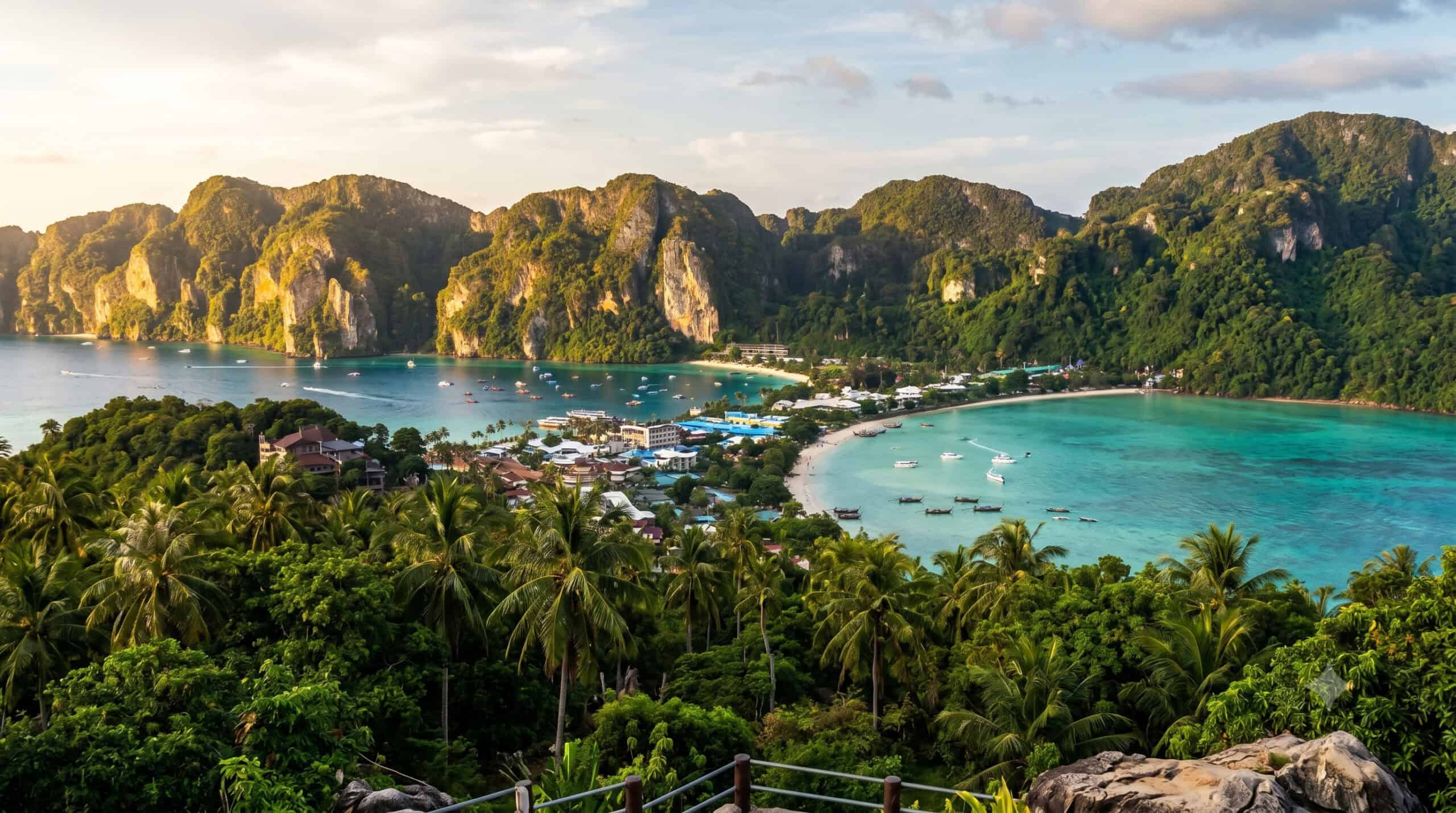
The panorama from the Phi Phi viewpoint hits you the moment the trees thin out: two perfect bays curling around either side of the island, limestone cliffs dropping straight into turquoise water, and a couple dozen other sweaty hikers doing exactly what you’re doing — trying to take the photo instead of just standing there staring. That’s a pretty good preview of what a well-planned trip to Phi Phi actually feels like. The place is real, and worth every kilometer of getting there. You just need a few smart decisions upfront.
This guide covers how to reach Phi Phi, what to do once you’re there, where the quieter beaches actually are, which dive operators are running trips in 2026, and what the deal is with Maya Bay — because yes, it’s open, but the rules have changed in ways that are worth knowing before you arrive.
Where Are the Phi Phi Islands?
The Phi Phi Islands (Koh Phi Phi) sit in Thailand’s Andaman Sea, roughly midway between Phuket and Krabi. There are two main islands: Phi Phi Don, the only inhabited one where you’ll sleep, eat, and base your trip — and Phi Phi Leh, the smaller uninhabited island that gets most of the day-trip boat traffic. Phi Phi Leh is where you’ll find Maya Bay, the lagoons, and the dramatic limestone scenery that featured in the 2000 film The Beach.
Phi Phi Don’s main village (Tonsai) is compact and car-free. Once you arrive by ferry, you’re on foot and longtail boats — which, honestly, is part of the appeal.
Getting to Phi Phi Islands: Ferries, Speedboats, and One Pre-Trip Step
Before you even think about pier logistics: if you’re flying into Thailand, the Thailand Digital Arrival Card (TDAC) is now mandatory for international arrivals. Complete it online before your flight — it’s free and takes a few minutes, but skipping it creates immigration delays. Sort it from home.
Once you’re in Thailand, most travelers reach Phi Phi by public ferry. Ferries run from:
- Phuket (typically Rassada Pier) — roughly 1.5 to 2 hours
- Krabi Town (Klong Jilad Pier) — roughly 1.5 hours; a smart choice if you’re already based in the Krabi area. See our guide to where to stay in Krabi for hotel options across every budget.
- Ao Nang — seasonal schedules, shorter crossing; confirm current timetables ahead of time
Speedboats are faster — around an hour from Phuket — but pricier and noticeably rougher in choppy sea conditions. If you’re prone to seasickness, take tablets before boarding (not once the nausea starts) and aim for a midboat seat. Book tickets a day or two ahead during peak season (December through March), and confirm whether pier transfers from your hotel or town are included in the price. A lot of people get caught flat-footed by having to arrange their own way to the pier.
Best Things to Do in Phi Phi Islands
Hike to the Phi Phi viewpoint. This is non-negotiable if you’re there for even one night. The trail climbs above Tonsai and opens out to a jaw-dropping twin-bay panorama — one of those views that makes people stop walking and just stand quietly. Go before 9am for cooler air, better light, and a fraction of the midday crowd. The view doesn’t change; your experience of it does.
Snorkeling. You don’t need a dive certification to see what’s under the water here. Half-day and full-day snorkel trips run regularly from Tonsai, or you can hire a longtail and hop between coves at your own pace. Look for operators that rotate between sites and actively avoid depositing thirty people onto the same small reef at peak hours — the difference in marine life visibility is significant.
Island-hopping around Phi Phi Leh. Most day-trip boats do a circuit of the lagoon scenery and limestone formations, with a Maya Bay stop if the bay is open. Read the section below on Maya Bay rules before you book — knowing what to expect means you actually enjoy it rather than feeling surprised by the restrictions.
Evenings. The main village gets lively after dark — beach bars, fire performances, and a social crowd that spans backpackers and resort guests alike. If that’s your scene, Tonsai delivers it. If an early night sounds better, staying in a beach area slightly outside town changes the noise equation considerably. Worth noting: Thailand has alcohol sales restrictions on certain public holidays and election days that apply even on the islands. Our guide to Thailand’s alcohol laws and nightlife rules covers the specifics so there are no surprises.
Diving at Phi Phi: What to Know in 2026
Diving around Phi Phi works well for a wide range of experience levels. The water is warm year-round, visibility is generally solid, and the mix of reef sections, limestone formations, and open-water passages gives dives real variety. Options run from try-dives and Open Water certifications up to advanced sites and the occasional technical trip.
Three dive operators currently active on Phi Phi with published schedules and course listings: Princess Divers (SSI-affiliated, active at princessdivers.com), The Adventure Club (PADI center with current trip schedules), and Island Divers / Phi Phi Island Divers (active dive-trip and center listings). If you’re staying at the northern end of the island near Laem Tong, some resorts run programs through established dive partners — ask your accommodation directly.
One thing worth confirming before you book: the King Cruiser wreck. Older guides still list it as a standout dive. The 2026 reality is that some operators have quietly pulled it from their schedules because the structure has deteriorated past what they consider safe to dive. If wreck diving is a priority, ask specifically what’s currently running — the Kled Gaeow wreck (an artificial reef sunk deliberately near Phi Phi) is offered by select operators and sits at advanced depths.
Before any dive trip, check that your travel insurance actually covers scuba diving, equipment loss, and medical evacuation. Standard travel policies routinely exclude all three, and emergency evacuations from a Thai island location can run into several thousand dollars. It’s one of those things that feels minor until you actually need it.
Finding Quieter Beaches on Phi Phi
The main village beach gets crowded, especially in the late morning through early afternoon window when tour boats arrive. But calmer spots do exist — you just need to go a bit farther or earlier:
- Laem Tong Beach — northern end of the island, more resort-oriented, noticeably quieter
- Long Beach — popular but calmer than the main waterfront; good for actual swimming
- Nui Beach — small cove best reached by boat, great for a few quiet hours
- Phak Nam Bay and Moo Dee Bay — more tucked away, both accessible by longtail
Longtail access and sea conditions vary with the season, so flexibility in timing helps. If the bigger draw is Thailand’s Andaman scenery without the high-season crowd, there are several lesser-known islands that deliver a similar experience at a fraction of the noise — we cover several of them in our guide to Thailand’s hidden islands.
Maya Bay in 2026: What’s Open, What Isn’t, and What You Can Do
Maya Bay is open — but it operates under a conservation framework that’s been in place since the bay was closed for environmental recovery from 2018 to 2022. If you visited in the pre-closure era when boats lined up inside the bay and swimmers packed every corner, this version will look different. Quieter. More managed. Honestly better, even if the rules require some adjustment.
For 2026, here’s what to know before you go: swimming is not allowed (wading to roughly knee depth is the standard); visitor numbers are controlled through managed access and tour coordination; and the bay closes for conservation every year. The 2025 closure ran August 1 through September 30, reopening October 1, 2025. A similar seasonal pattern is expected in 2026. If your travel dates fall anywhere near that August–September window, confirm current status with your tour operator before building Maya Bay into your plans.
On entry fees: Phi Phi falls within the Hat Noppharat Thara–Mu Ko Phi Phi Marine National Park. The standard fee is 400 THB for adults and 200 THB for children, as listed by the Tourism Authority of Thailand. Since October 15, 2025, entry to this and five other marine parks has been managed through a new e-ticket system. Your tour operator should handle the actual process, but confirm ahead of time so you’re not sorting it out on the spot at the pier.
How Much Time Do You Need? Sample Itineraries
One day is enough to hit the highlights, but you’ll need to move with some intention. Two to three days is the version where you actually slow down.
If You Have One Day
- Morning: viewpoint hike — do this first, before the heat and the crowds
- Midday: beach time at Long Beach or a boat-access cove
- Afternoon: snorkeling trip
- Evening: dinner in Tonsai + easy beachfront walk
If You Have 2–3 Days (the Sweet Spot)
- Day 1: arrive, settle in, viewpoint hike, explore the village
- Day 2: full Phi Phi Leh boat day — lagoon scenery, Maya Bay (if open), snorkeling stops
- Day 3: diving day or a slower beach-and-snorkel combination; catch the sunset from a boat or the viewpoint
Phi Phi fits naturally into a broader southern Thailand circuit — a few days in Krabi, a ferry to Phi Phi, then back to Phuket for your flight. If you’re building a longer trip, our 10-day Thailand itinerary shows how to sequence the south with Bangkok and Chiang Mai without doubling back unnecessarily.
Frequently Asked Questions About Phi Phi Islands
Can you still visit Maya Bay in 2026?
Yes — Maya Bay is open and accessible by tour boat. But it’s managed as a conservation zone: swimming is not allowed (knee-depth wading only), visitor numbers are capped, and there’s an annual seasonal closure. The 2025 closure ran August through September. Check the current status with your tour operator before finalizing plans if your trip window is anywhere near that period.
Is it better to go to Phi Phi from Phuket or from Krabi?
Both work well and the crossing time is roughly similar — around 1.5 to 2 hours from either. Phuket tends to have more frequent departures and more departure time options throughout the day. Krabi or Ao Nang makes more sense if you’re already exploring that coastline. Neither is wrong — it comes down to where you’re basing yourself.
Is Phi Phi a good destination for first-time divers?
Yes. Several active dive centers on the island run try-dives and Open Water certifications in calm, warm water with experienced instructors. Princess Divers and The Adventure Club are two well-established options currently operating with published course schedules. It’s a solid place to get certified — good conditions and no pressure to rush.
Do I need to complete a Thailand Digital Arrival Card (TDAC) before visiting?
Yes — TDAC is now mandatory for all international arrivals into Thailand. Complete it online before your flight. It’s free, takes a few minutes, and is not optional. Failing to do it before landing creates immigration delays for you and everyone behind you in the queue.
What is the national park entry fee for Phi Phi?
400 THB for adults and 200 THB for children, as listed by the Tourism Authority of Thailand. Entry is now processed through an e-ticket system (launched October 2025 for six marine parks including Phi Phi). Your tour operator should handle this — confirm in advance so there’s no confusion at the pier.
What’s the current Thailand visa policy for 2026?
Thailand’s cabinet voted in May 2026 to revert the visa-free stay period from 60 days to 30 days for many nationalities, though this was pending official publication in the Royal Thai Gazette as of mid-2026. Check the current status for your specific passport before booking — the Tourism Authority of Thailand and your country’s embassy are the most reliable sources.
Phi Phi Islands are still one of the most visually impressive destinations in Southeast Asia — and visiting with a bit more intention these days actually makes the experience better, not worse. Book smart, start your mornings early, and check the Maya Bay calendar before you commit to dates. The islands will handle the rest.