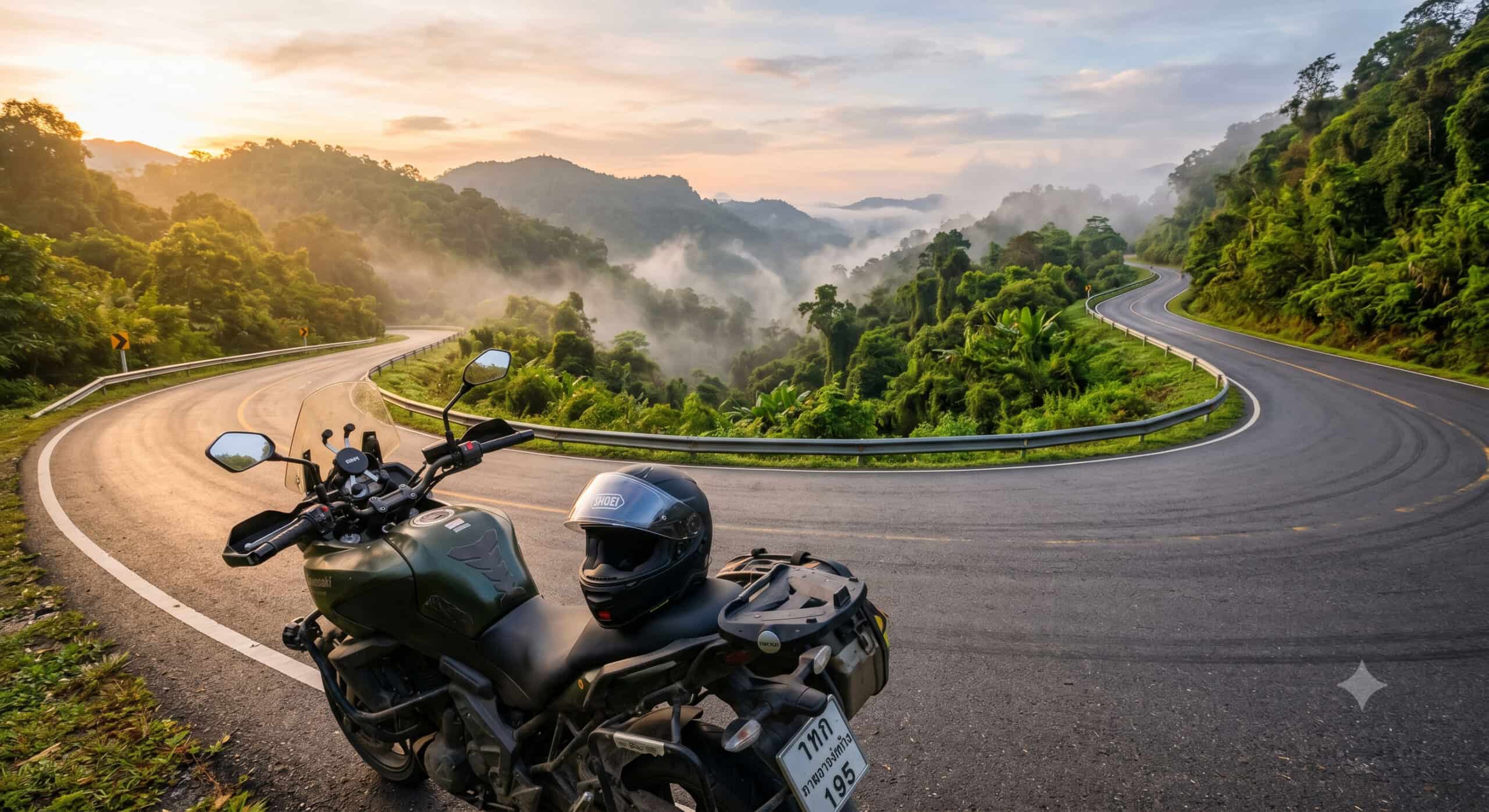
There are moments in Thailand that a tour bus can’t give you — the smell of rain on a mountain road at 7am, a hand-lettered waterfall sign that wasn’t in any guide, a stretch of smooth asphalt threading through rice fields that seems to go on forever. A motorcycle road trip through Thailand is one of the best ways to find them. This guide covers what you actually need to know: licensing reality, insurance basics, the best routes for different skill levels, and the standout stops that make the extra effort worth it.
Who Thailand Motorbike Trips Are (and Aren’t) For
A Thailand motorcycle road trip is a good fit if you have real riding experience — not just a week on a scooter in Bali, but actual time in the saddle on hilly, curving, and unpredictable roads. You’re comfortable with variable traffic, fine with flexible plans, and treat the ride itself as the destination, not just the transport.
It’s worth skipping if you haven’t ridden in years, if your only reference point is beach scooting, or if you feel any pressure to keep up with others on the road. Thailand’s mountain routes are genuinely beautiful, but they’re also fast-moving and full of surprises: trucks on blind corners, dogs in the lane, gravel past the apex. The riders who have the best trips are the ones who ride defensively, rest often, and don’t feel like the schedule is the boss. Our Thailand travel tips guide for 2026 covers alternative ways to see the country — including guided tours and driver hires — if riding doesn’t feel like the right fit.
Licenses, IDP, and Insurance: Get This Right Before You Fly
What the law requires
Thailand requires visiting drivers — car or motorcycle — to carry a valid International Driving Permit (IDP) alongside their home license and passport. This trips up a lot of riders: your IDP must specifically cover motorcycles. If your home license doesn’t include a motorcycle class, the IDP won’t either, and you’ll be in violation of Thai law regardless of what a rental shop tells you or what keys they hand over. Thailand’s official guidance for foreign nationals confirms the requirement. Sort out your licensing endorsement at home before you fly — there’s no shortcut.
Two things worth knowing: First, licensing gaps can void insurance coverage, even when a rental shop didn’t ask to see your documents. Second, if you’re riding a larger-displacement bike (500cc+), check whether your IDP class covers it specifically — some permits distinguish engine sizes.
Travel insurance for motorcyclists
Standard travel insurance often excludes motorcycling — or includes so many conditions that a claim gets denied anyway. Before you buy a policy, look for: explicit coverage for motorcycle riding, engine size compatibility with the bike you’re renting, a clear helmet-use clause (most require it), and a medical evacuation provision. SafetyWing is one option that actively markets to motorcycle travelers and was still operating as of early 2026, but any insurer can have exclusions — read the policy, not just the summary page.
Save these emergency numbers in your phone before your first ride: 191 (general emergency), 1669 (ambulance), 199 (fire), and 1155 (Tourist Police, useful for language assistance and traveler-specific situations).
How to Ride Smart on Thailand’s Roads
The mindset that works best in Thailand is riding as if you’re invisible — because to a lot of drivers, you basically are. Assume every intersection has someone pulling across unexpectedly, and leave space before you feel like you need it.
Wear a helmet on every single ride. Thailand upgraded its helmet enforcement significantly under the Royal Thai Police’s Safe Roads Project, which took effect June 1, 2025. Both rider and passenger now face fines up to 2,000 THB, doubling to 4,000 THB if neither is wearing one. Enforcement is real and increasing, particularly in tourist areas. The fine is the least of your concerns — the helmet matters because Thailand’s roads aren’t forgiving.
Skip night riding. Visibility drops quickly, road hazards multiply, and tiredness catches up faster than it seems. Start each day early, end before dark. In rain, slow down more than feels necessary — painted road markings, metal manhole covers, and puddles can be as slick as ice. Take breaks often: heat, dehydration, and adrenaline combine into a sneaky combo that dulls your reactions before you notice.
The Best Thailand Motorcycle Road Trip Routes
Thailand’s riding options range from a half-day loop outside Chiang Mai to a two-week journey through mountains, temples, and border crossings. Here are the routes worth knowing.
1. The Mae Hong Son Loop — Northern Thailand’s Classic Ride
Best for: Confident, experienced riders who want mountain scenery and real road challenge
Distance: ~600 km
Time needed: 4–7 days (more is better)
This is the one most serious riders come for. The loop runs from Chiang Mai north through Pai and Mae Hong Son, then south through Mae Sariang before curving back to the city. Highway 1095 through those mountains — thousands of curves, misty ridgelines, cool morning air — is a legitimate riding highlight. It’s physically demanding, and that’s the whole point.
Practical tips: start early each morning for cooler temps and clearer skies; plan shorter riding days than you think you need (the curves eat more time than the map suggests); treat Pai as a rest stop, not a destination to rush through. Chiang Mai is the natural base city for this route — see our Chiang Mai travel guide for the temples, night markets, ethical elephant experiences, and practical tips worth knowing before you arrive.
2. The Samoeng Loop — Chiang Mai’s Short-But-Satisfying Ride
Best for: Newer riders, or anyone with half a day to spare
Distance: ~100 km
Time needed: Half day to full day
Think of this as the ideal warm-up before committing to the Mae Hong Son Loop. The Samoeng Loop takes you out of Chiang Mai through decent mountain scenery without the full-day commitment or technical challenge. Stop often, grab coffee somewhere with a view, and use it to calibrate your comfort level with Thai traffic before heading deeper into the mountains.
3. Chiang Mai to Chiang Rai and the Golden Triangle
Best for: Riders who want history and culture alongside the scenery
Distance: ~180 km point-to-point (more as a loop)
Time needed: 3–5 days
This route mixes rolling northern terrain with temple stops, tea and coffee country outside Chiang Rai, and the Golden Triangle where Thailand, Laos, and Myanmar meet. It’s a good fit if you like getting off the bike for short hikes and slow lunches — the pace suits the scenery. You can run it as a loop or a point-to-point depending on your schedule.
4. Isaan: Udon Thani and Talay Bua Daeng
Best for: Travelers who want something genuinely different from the standard Thailand circuit
Time needed: 2–4 days (more if you explore deeper into Isaan)
Northeastern Thailand (Isaan) barely shows up on most travel itineraries, which is exactly why it’s worth the detour. Udon Thani makes a solid base, and the main attraction is Talay Bua Daeng — known in English as the Red Lotus Sea or Lotus Lake — where thousands of pink lotus flowers bloom across a shallow lake at sunrise. The spectacle peaks roughly from late December through February, and it genuinely lives up to the photos. Boat tours typically run around 300–500 THB depending on boat size (verify locally before arrival, as prices change seasonally).
Plan an early bedtime the night before the lake visit — you want to be on the water when the mist is still up and the flowers are fully open, which means a pre-sunrise start.
5. Central Thailand: Kanchanaburi, Pattaya, and the Sanctuary of Truth
Best for: Riders based in or passing through Bangkok
Time needed: 2–4 days
If you’re starting or ending your trip in Bangkok, the central corridor has two worthwhile detours. Kanchanaburi — home of the Bridge Over the River Kwai and the Burma Death Railway — is a sobering half-day stop with real historical weight. Further along toward Pattaya, the Sanctuary of Truth is one of those places that converts even non-architecture travelers: a massive, entirely hand-carved wooden temple complex on the seafront. It runs daytime and evening touring windows — check the official site before you go.
Renting vs. Buying a Bike in Thailand
For trips under two or three weeks, renting wins on nearly every measure: less paperwork, no resale risk, and the flexibility to return the bike in a different city. When you pick up a rental, photograph every existing scratch and dent before you leave the lot, test brakes, lights, and tires, confirm the flat tire policy (flats are common on mountain roads), and never hand over your passport as a deposit — that’s a dealbreaker.
Buying can be cost-effective if you’re staying a month or more and are realistic about resale timing and basic maintenance. For most travelers, the simplicity of renting is worth more than the potential savings — and simplicity reduces stress, which is a road safety factor in its own right.
Best Time to Ride + What to Pack
The cool season (roughly November through February) is when most riders plan their trip: lower temperatures, better visibility, and more predictable road conditions. March through May gets genuinely hot, and the rainy season (May through November) makes northern mountain roads significantly more technical — beautiful, but wet and occasionally closed. One note specific to Northern Thailand: the burning season around March and April brings agricultural haze that can affect air quality and mountain visibility enough to meaningfully change the experience.
What to bring, in priority order: a lightweight riding jacket with armor (a regular travel jacket isn’t a substitute), gloves (hands absorb impact in a fall), closed-toe shoes or ankle-height boots, a rain layer even in the dry season, sunglasses plus clear glasses for low-light riding, a small first aid kit, a phone mount with offline maps downloaded, and copies of your passport, home license, and IDP stored separately from the originals.
Budgeting Your Thailand Motorcycle Trip
The main cost buckets are bike rental or purchase, fuel (mountain routes use more than you’d estimate), accommodation, food, gear, and insurance. The smart move is to spend more on the things that affect safety — gear, a well-maintained rental, and proper coverage — and less on rushing the schedule. Slow travel almost always costs less, and the days you’ll most want to relive are usually the ones that weren’t planned.
Many riders finish a northern loop and head south to decompress on the islands. If that’s your plan, check out our guide to the best places to stay in Krabi or browse our Thailand hidden islands guide for quieter options away from the bigger beach crowds.
Frequently Asked Questions About Thailand Motorcycle Road Trips
Is it safe to ride a motorcycle in Thailand?
It can be, if you ride defensively, wear a proper helmet, and stay within your skill level. Thailand consistently ranks among countries with high road fatality rates, so this isn’t the place to push limits or experiment. The riders who do well are the ones who take it seriously before they arrive — proper licensing, appropriate gear, good insurance — and ride conservatively once they’re there.
Do I need an International Driving Permit (IDP) to ride in Thailand?
Yes. Thailand’s official guidance for foreign nationals requires an IDP alongside your home license and passport. The IDP must cover motorcycles specifically — if your home license doesn’t include a motorcycle endorsement, neither will the IDP. Even if a rental shop doesn’t ask to see your documents, insurance coverage can be voided if you weren’t properly licensed at the time of an incident.
What’s the best motorcycle route in Thailand for first-timers?
If you’re newer to Thai roads, start with the Samoeng Loop outside Chiang Mai — a half-day ride with mountain scenery that lets you calibrate to local traffic patterns before committing to anything bigger. Experienced riders typically head straight for the Mae Hong Son Loop, which at around 600 km is the country’s most celebrated road trip for good reason.
Where should I base myself for northern motorcycle trips?
Chiang Mai is the answer for almost every northern route. It has the best selection of rental shops, good road access in every direction, and solid infrastructure for riders. It’s also a genuinely enjoyable city to spend a rest day in — see our Chiang Mai travel guide for the temples, food, and experiences worth your time while you’re there.
What months are best for a Thailand motorcycle road trip?
November through February for most routes — cool, dry, and clear. Avoid the burning season in the north (roughly March through April) if air quality or visibility concerns you, and plan carefully if you’re riding between May and November. The rainy season doesn’t make riding impossible, but it adds real complexity to mountain routes.
What are the most important emergency numbers to save in Thailand?
Before your first ride, save these: 191 (general emergency), 1669 (ambulance), 199 (fire), and 1155 (Tourist Police — useful for traveler-specific situations and language help). Also save your travel insurer’s emergency number separately, and store all of these in a note app rather than relying on call history.
Thailand Rewards Riders Who Take Their Time
A motorcycle road trip through Thailand rewards patience more than speed. The backroads, the early starts, the towns you stop in because the sign looked interesting — that’s where the best memories come from. Plan it carefully, ride it conservatively, and leave space in the itinerary for the days that surprise you. Those tend to be the best ones.