
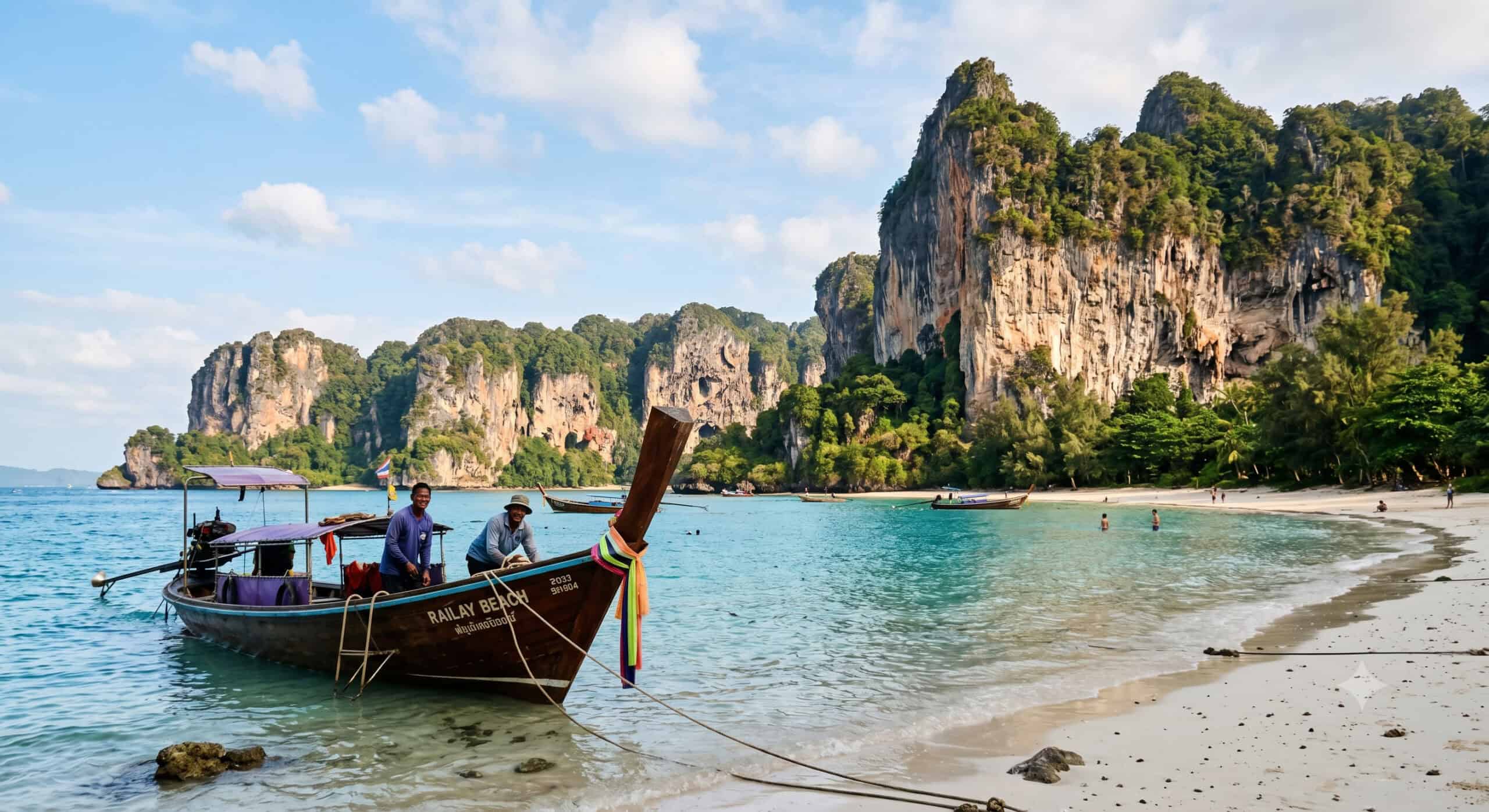
Krabi makes Phuket look a little hectic by comparison. Same Andaman Sea, same dramatic limestone scenery — but quieter, more laid-back, and with a “choose your own day” flexibility that keeps people coming back. You can be at a car-free beach by longtail boat by 9am, halfway up 1,260 stone steps by noon, and eating $3 roti at a night market by 8pm. That’s Krabi at its best.
Here are the 10 best things to do in Krabi, along with the planning basics worth knowing before you arrive.
Plan Your Krabi Trip Right
Before getting into the attractions, a few logistics that actually affect your trip. Krabi International Airport (KBV) is serviced by Bangkok Airways, Thai AirAsia, and Thai Lion Air, with direct flights from Bangkok running about 1.5 hours. You can also arrive overland via overnight bus or ferry connections from Phuket, Koh Lanta, or Koh Samui.
Your base shapes everything. Ao Nang is the most practical choice for first-timers — it has restaurants, tour desks, decent nightlife, and longtail access to Railay. Railay (boat-access only, no roads) is ideal if you want to slow down or rock climb. Krabi Town is the pick for local markets, budget guesthouses, and a more everyday feel. For a detailed breakdown of guesthouses, resorts, and areas, our guide to where to stay in Krabi covers each zone with current listings.
Best time to visit: November through April is the dry season — the most reliable window for boat trips, beach days, and the Tiger Cave climb. May through October is green season: cheaper flights, fewer crowds, lush scenery, but frequent rain and occasional boat trip cancellations. If you’re visiting during a Buddhist holiday, alcohol sales may be restricted at some venues — worth reading up on Thailand’s alcohol laws so nothing catches you off guard.
Railay Beach and Phra Nang Cave
Railay is Krabi’s most famous spot, and it genuinely lives up to the hype. Towering limestone cliffs, clear turquoise water, soft sand, and a logistical quirk that keeps it from getting overrun: the only way in is by boat. No road access exists — Railay is a peninsula cut off by jungle and karst walls — so you don’t get the bus-tour traffic you’d find at more accessible Thai beaches.
Longtail boats run from Ao Nang throughout the day (about 10–15 minutes, shared boats cost around 100–150 THB per person). Once there, East Railay and West Railay are connected by a short walkway through a low-lying path, with Phra Nang Beach at the far end. Phra Nang is arguably the most dramatic of the three: a tucked-away cove beneath a sheer cliff face, with a cave at one end that functions as an active spiritual site. Local fisherfolk leave offerings there tied to sea-faring folklore and beliefs. Come respectfully — it’s not a photo prop.
If rock climbing is on your list, Railay is one of Southeast Asia’s best sites for it. Dozens of schools operate directly from the beach with routes for beginners through advanced climbers. A half-day beginner session with gear rental and instruction typically runs 800–1,200 THB and is worth doing even if you’ve never climbed before. One practical note: monkeys are plentiful and experienced. Keep food zipped inside your bag at all times.
Tiger Cave Temple — Earn That View
Tiger Cave Temple (Wat Tham Suea) gets the most attention for its staircase — and fairly so. The climb to the summit is 1,260 steps winding up a limestone mountain, steep for most of it, and done in full Thai heat and humidity. A sign at the base still reads 1,237, a leftover from before a section was renovated, so don’t trust it. Budget 45 minutes to an hour going up, depending on fitness and how many rest stops you need.
At the top: a golden Buddha, a golden chedi, a small shrine, and a 360° view stretching across jungle, limestone karst peaks, and the Andaman coast. It’s the kind of payoff that makes the sweat feel worthwhile. Take off your shoes at the tiled summit area — it’s an active temple, not a lookout.
The base of the temple is worth time on its own. There are meditation caves, forest shrines tucked between limestone rocks, monk residences, and quieter walking paths through the jungle. If stairs aren’t your thing, this lower section called Wonderland is a peaceful alternative with about 187 steps and full shade.
Practical tips: go early (7:30–8am before the heat peaks), bring a full water bottle, wear shoes with grip, and cover shoulders and knees. The temple is about 9 km northeast of Krabi Town — a tuk-tuk or songthaew from town runs roughly 100–200 THB.
Island Hopping and Outdoor Day Trips
Krabi’s geography puts some of Thailand’s best islands and marine areas within easy reach. A few options worth knowing about:
The Four Islands Tour is the standard day-trip package from Ao Nang — a speedboat or longtail loop hitting four small islands with snorkeling stops, a beach lunch, and swimming. Well-organized, good value for a full day, and easy to book from any tour desk. Prices typically run 700–1,500 THB depending on whether you go by longtail or speedboat.
The Phi Phi Islands are about 45 minutes from Krabi by speedboat and are a popular half-day or full-day excursion. Ko Phi Phi Le is the island with Maya Bay, the famous cove from the film The Beach. Day tours that include Maya Bay, Viking Cave, and Monkey Beach sell out fast during high season — worth booking a day ahead. We have a full guide to exploring the Phi Phi Islands with more detail on what to expect.
If you want to avoid the crowds and find quieter spots, some of southern Thailand’s best under-the-radar islands are within easy reach of Krabi. Our guide to Thailand’s hidden islands covers six lesser-known options worth adding to your itinerary.
For a slower-paced option, a mangrove kayak tour through the channels near Krabi Town is a nice contrast to boat trips — you paddle between limestone formations at water level, often ending near the iconic Khao Khanab Nam twin peaks. Half-day, peaceful, and easy to combine with the cave visit below.
The Fossil Shell Cemetery and Krabi’s Quirky Cultural Stops
Susan Hoi (Fossil Shell Cemetery) is one of those places that sounds unremarkable until you’re actually standing on it. What looks like cracked concrete slabs at the edge of the sea is actually compressed fossilized freshwater snails — shells that accumulated over roughly 40 million years and hardened into shelly limestone. Scientists consider it one of only a few such formations of this scale in the world (some sources say two others exist, in the US and Japan).
It’s about 10–17 km from Ao Nang, with best viewing at low tide. The foreign entry fee is 400 THB, which some visitors find steep for the stop alone. If you’re genuinely into geology or unusual natural history, it’s absolutely worth the trip. If you’re looking for something beach-adjacent, the area near the fossil beds has a small free beach that’s quiet and rarely crowded.
Khao Khanab Nam — the two photogenic limestone formations rising from the Krabi River — is best reached by longtail from Krabi Town. You can explore the cave area on foot inside, where human skulls were discovered (believed to be prehistoric settlers). The scenery is classic Krabi and a good reason to spend time near the town rather than rushing straight to the beach.
Wat Kaew Korawaram, the white hilltop temple above downtown Krabi Town, is an easy stop for a quiet morning visit. Bright white architecture, peaceful atmosphere, and good elevated views over town. Cover shoulders and knees, speak quietly, and remember it’s an active place of worship.
Krabi Town: Night Markets and Local Food
If you’re staying anywhere near Krabi Town, the Weekend Night Market (Walking Street) is the easiest meal decision you’ll make. It runs Friday, Saturday, and Sunday evenings — typically 5pm to 10pm — with street food stalls, occasional live music, local craft vendors, and a relaxed crowd of locals and travelers mixed together. Go where the lines are: grilled skewers, roti with banana and condensed milk, fresh coconut shakes, papaya salad, and seafood from the grill are usually the stars.
Thara Park, right along the Krabi River, is where the town slows down — locals come to jog, eat, play sport, and watch the sunset from the riverside benches. It’s one of the best spots in Krabi to spend time around everyday Thai life rather than tourist infrastructure. Late afternoon into sunset is the best window.
A few dishes to put on your Krabi eating checklist: Penang curry (richer and slightly sweeter than a standard red curry, very aromatic), som tam papaya salad (specify your spice level — “pet nit noi” for mild), fresh grilled seafood near Ao Nang’s beach strip, and roti from a night market stall. The banana-condensed milk roti is exactly as good as everyone says.
Ethical Elephant Experiences in Krabi
If elephants are on your Krabi list, the ethical standard is clear: no riding, no performances, no bullhooks. What you’re looking for is a sanctuary model — observation, feeding, and natural behavior in a calm environment with space and shade.
Two operators in the Krabi area with active online listings at the time of writing: The Elephant Sanctuary Krabi (explicitly markets a no-riding policy) and Krabi Elephant House Sanctuary (currently taking bookings). Before booking any elephant experience, a quick check: Are riding or trick performances advertised? If yes, skip it. Do the promotional materials show calm, natural interactions and plenty of space? That’s what ethical looks like.
Frequently Asked Questions About Things to Do in Krabi
How many days do you need in Krabi?
Three to five days covers the main highlights comfortably — Railay Beach, Tiger Cave Temple, one island day trip, and time to explore Krabi Town without rushing. If you want to add rock climbing sessions or a longer island excursion to the Phi Phi Islands, five to seven days is more comfortable.
Is Railay Beach only reachable by boat?
Yes — there is no road access to Railay. The peninsula is cut off by limestone cliffs and jungle, so the only way in or out is longtail boat. Boats depart from Ao Nang and Krabi Town throughout the day and into the evening. The ride from Ao Nang takes about 10–15 minutes.
How hard is the Tiger Cave Temple climb?
It’s genuinely challenging — 1,260 steep, uneven steps in Krabi’s heat and humidity. Most reasonably fit people reach the top in 45 minutes to an hour. The descent is easier on the lungs but tough on the knees. Start early, bring a full water bottle, and wear shoes with grip. There’s a filtered water fountain at the summit.
What is the best time of year to visit Krabi?
November through April is the dry season and the most reliable window for beaches, boat trips, and outdoor activities. May through October brings lower prices and fewer crowds, but frequent rain and rough seas that can cancel tours. If reliable beach and boat weather matters to your trip, aim for the dry season.
Is Krabi better than Phuket for first-time visitors?
They suit different travel styles. Phuket is bigger, with more nightlife, more resort options, and busier infrastructure. Krabi is better for outdoor adventures, rock climbing, quieter beaches, and a more relaxed pace. Many people visit both on a single trip — they’re about 2.5–3 hours apart by road, or roughly an hour by speedboat ferry. If you’re also considering Hua Hin as a stop on a broader Thailand trip, our guide to things to do in Hua Hin is worth a look — it’s a completely different feel.
What is the Fossil Shell Cemetery in Krabi?
Susan Hoi — also called the Fossil Shell Cemetery — is a natural geological site near Krabi Town where millions of freshwater snails were fossilized over approximately 40 million years and compressed into thick limestone slabs. Scientists consider it one of only a few such formations of this scale in the world. It’s located about 10–17 km from Ao Nang and is best viewed at low tide, when the fossil beds are most visible.
Krabi rewards travelers who show up with a rough plan and leave room to fill in the gaps. Set your alarm early for Tiger Cave, book your Railay boat the evening before, and let the night market handle dinner. You won’t run out of things to do.